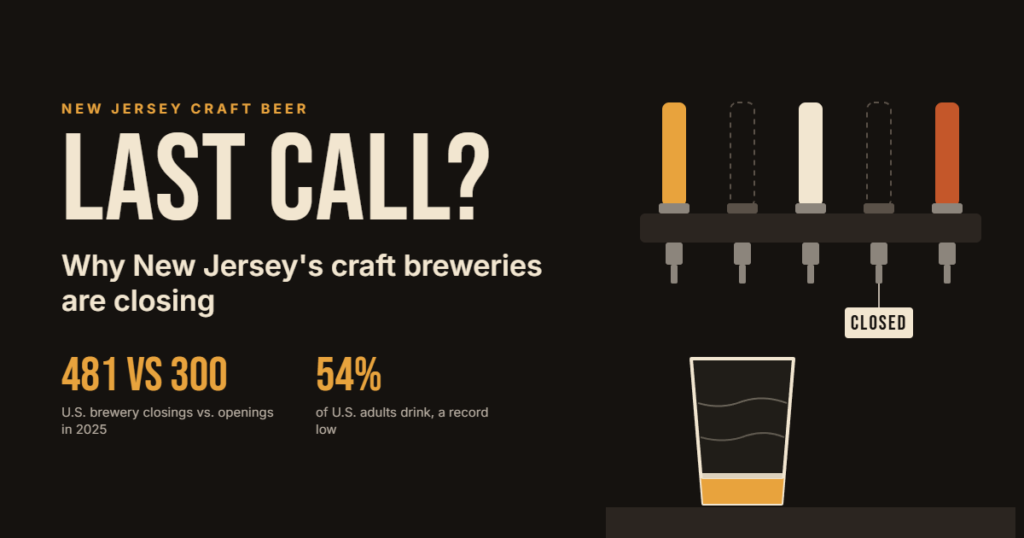
New Jersey’s craft beer boom is running in reverse, and it is not one villain doing the damage. Fewer people are drinking, the cost of making and canning beer has jumped, and a market that doubled in a decade is now fighting over a shrinking pie. State regulation did real harm from 2019 to 2023, but most of those rules were repealed in January 2024. The idea that the beer simply got boring is the weakest explanation of the bunch.
The last few weeks in South Jersey tell the story. In mid-November, Sons of Barley Beer Co. in Woodbury Heights announced it was closing almost exactly one year after it opened on Mantua Pike. A few weeks earlier, Berlin Brewing said it would close its White Horse Pike taproom after 12 years, and Whims Brewing in Atco said it would shut down by the end of 2026. Three Camden and Gloucester County breweries, gone in about a month.
The closures
Since 2024, the casualties have ranged from one-year-old taprooms to the state’s oldest craft names. Where an owner gave a reason, it was almost always money: rent, leases or debt.
| When | Brewery | Town | What happened |
|---|---|---|---|
| Nov 2026 | Sons of Barley Beer Co. | Woodbury Heights | Closed one year after opening; no reason given |
| Oct 2026 | Berlin Brewing | Berlin | Closing taproom after 12 years; owners had tried to raise up to $70,000 from investors in 2025 |
| Oct 2026 | Whims Brewing | Atco | Closing by end of 2026 |
| Jul 2026 | River Horse | Ewing | Tasting room closing; production moves to an out-of-state brewery in Jan 2027 after lease renewal proved too expensive |
| Mid 2026 | Eight & Sand Beer Co. | Woodbury | Closed after 10 years; another brewery is taking the space |
| Feb 2026 | Brix City Brewing | Little Ferry | Chapter 11 filing; its taproom had closed in May 2025 over rising rent |
| Sep 2025 | Iron Hill Brewery | Voorhees, Maple Shade | Whole chain closed overnight, then filed Chapter 7 in NJ with about $20 million in liabilities |
| Jun 2025 | Fox House Brewing | Bordentown | Closed permanently |
| Mar 2025 | Brotherton Brewing | Atco | Closed; reopened under a new owner in 2026 |
| Jan 2024 | The Alementary | Hackensack | Closed citing multiple business challenges |
| Early 2024 | Forgotten Boardwalk | Cherry Hill | Closed after failing to extend its lease |
| Dec 2023 | Flying Fish | Somerdale | Chapter 11 filing by the brewery that helped start NJ craft in 1995 |
The big-beer side is shrinking too. Anheuser-Busch sold its Newark brewery, open since 1951, as part of a nationwide consolidation.
The numbers
Nationally, more breweries have closed than opened for two straight years. The Brewers Association counted 591 closings against 518 openings in 2024, and 481 against 300 in 2025, with craft production down about 5% in 2025. The slide continued into this year: craft volume fell another 4% in the first half of 2026, and NielsenIQ store data showed craft down 5.2%.
One detail matters for the “bad beer” theory: craft is falling more slowly than beer overall. Craft’s share of the beer market actually ticked up, from 13.2% to 13.3% in 2025, while total beer volume fell 5.7%.
New Jersey got to the party late and fast. The state went from 22 craft breweries in 2012 to 130 in 2020, and the Brewers Association counted 168 breweries in 2024. Even so, NJ ranks 41st in breweries per capita, at 2.4 per 100,000 adults.
Open question: NJBIZ reports that NJ lost roughly 1 in 5 breweries between 2019 and 2025, but that figure does not square with the Brewers Association’s 2024 count. Confirm the source with the Brewers Guild of New Jersey before publishing a net-loss number.
Are people drinking less?
Yes, and this is the biggest single factor. Gallup found that only 54% of U.S. adults drank alcohol in 2025, the lowest reading since it started asking in 1939. The 2026 survey held at that same record low.
- Health worries are mainstream. For the first time, a majority of Americans (53% in 2025, 51% in 2026) say even one or two drinks a day is bad for you.
- Young adults are pulling back hardest. The share of 18 to 34 year olds who drink fell from 59% in 2023 to 50% in 2025.
- Drinkers drink less often. In 2025, 40% of drinkers said it had been more than a week since their last drink, the highest since 2000.
- Substitutes are real. In 2026, 17% of Americans said they had swapped in nonalcoholic beer, wine or spirits.
A taproom is built on regulars who come in two or three times a week. When those regulars start coming twice a month, a small brewery with a fixed lease feels it immediately. Industry groups elsewhere point to a related shift: less in-person socializing since the pandemic.
Is it government regulation?
Partly, but mostly as old damage plus one new hit from Washington. Trenton’s worst rules are gone.
The 2019 to 2023 squeeze. New Jersey’s Division of Alcoholic Beverage Control issued a special ruling that, once enforced from July 2022, limited taproom events, restricted food trucks and barred selling drinks not made on site. The state’s stated idea was that taprooms should be a stepping stone to bars, not a destination. Breweries spent years fighting it while still recovering from COVID.
The 2024 fix. On January 16, 2024, Gov. Murphy signed S-4265/A-5912. It allows unlimited on-site events, 25 off-site events a year, food truck and restaurant partnerships, and snacks and soft drinks. That relief came too late for some: The Alementary announced its closing weeks later.
Still on the books. New Jersey’s capped liquor license system leaves in-state brewers competing for tap handles. Bolero Snort co-owner Scott Wells has argued that out-of-state distributors control much of the tap space at NJ bars and restaurants.
The new federal hits. Aluminum tariffs rose from 25% to 50% in June 2025 (Shore News Network), and most craft beer ships in cans. Separately, hemp THC seltzers had become a lifeline for some breweries. New Jersey capped those drinks at 10 mg per container from May 2026 with a November 13 sales deadline, and a federal ban takes effect December 11, 2026. One more side business is closing off.
Is the beer just not exciting anymore?
The evidence says no. The problem is not boring beer; it is too many good breweries chasing too few drinkers.
- Craft is holding share. Craft gained market share in 2025 while beer overall fell faster.
- Fans are still engaged. In a 2026 Brewers Association and Harris Poll survey, 85% of craft drinkers said they drink craft monthly, up 10 points from the year before.
- Quality is not the complaint. The state’s first New Jersey Brewers Cup in 2026 was a showcase for in-state brewers.
The real issue is crowding. The U.S. has roughly twice as many craft breweries as a decade ago. When ten taprooms within a short drive all pour a hazy IPA, a lager and a fruited sour, a new one has little to set it apart. Sameness matters less than math: the same shrinking pool of drinkers is being split more ways.
The cost squeeze
While sales soften, nearly every input has gotten more expensive, and small brewers say customers will not accept higher pint prices to cover it.
- Cans. About 78% of packaged craft beer is sold in cans, and can prices rose 25% or more after the tariff increase (Shore News Network).
- Labor. Brewers Association benchmarking puts direct labor at $121.10 per barrel, up from $85.60 in 2018.
- Rent and leases. This is the cause owners name most. Brix City’s taproom closed over rising rent, River Horse called its lease renewal cost-prohibitive, and Forgotten Boardwalk could not extend its lease.
- Debt. Iron Hill listed about $20 million in liabilities against roughly $165,000 in assets when it filed for bankruptcy. Many breweries borrowed to build out during the boom.
The taproom is still the best business in beer: taproom sales earn about $1,276 a barrel versus $602 for beer sold through distributors. That is exactly why fewer taproom visits hurt so much.
Who survives, and what comes next
The breweries still standing are the ones making the taproom about more than a pint. The rest of the industry is shrinking toward a smaller, steadier size.
- Using the 2024 law. Cranford’s Yale Terrace Brewery opened a coffee shop in its taproom that opens at 5:30 a.m., something the old rules would not have allowed.
- Sharing equipment. River Horse kept its beer on shelves by moving production into a shared facility through an alternating proprietorship, instead of carrying its own building.
- New owners, same taps. Brotherton Brewing in Atco closed in 2025 and reopened under a new owner in 2026. Eight & Sand’s Woodbury space is getting a new brewery too.
- Selling to non-drinkers. NA beers and seltzers are now standard taproom offerings.
The Brewers Association’s economist calls the outlook “cautious optimism”: closings fell from 591 in 2024 to 481 in 2025, and openings fell even faster. That reads less like a collapse and more like a shakeout. Expect fewer New Jersey breweries a year from now, but the survivors will likely be leaner, more local and less dependent on any one product.
Worth asking the owners for a follow-up: which costs went up most since 2023, how weekday taproom traffic compares to 2019, and whether the end of THC seltzer sales changes their 2027 plans.
Sources
- Brewers Association: A Year of Correction for Craft Beer (2025 data)
- New School Beer: 2026 Midyear Report on the Craft Beer Industry
- Gallup: U.S. Drinking Rate at New Low (2025)
- Gallup: Americans’ Drinking Remains at Record Low (2026)
- Shore News Network: Last Call, Why New Jersey’s Craft Breweries Are Closing
- NJBIZ: Sons of Barley latest South Jersey brewery to close
- NJBIZ: Whims Brewing to close Atco taproom
- Yahoo/Courier-Post: Berlin Brewing closing
- NJ 101.5: River Horse Ewing tasting room closes
- Brix City Brewing bankruptcy docket, D.N.J. 2:26-bk-11340
- 6abc: Iron Hill Brewery closes all locations
- NJ Governor’s Office: liquor license reform signed, Jan 16, 2024
- Brewbound: NJ guild on 2022 taproom limits
- NJBIZ: Lawmakers weigh measure to nurture NJ craft brewing
- MJBizDaily: NJ hemp law changes
- Foley Hoag: Federal hemp THC ban delayed to Dec 11, 2026
- Cambridge: The beer garden state, NJ brewery clustering
- Patch: NJ brewery count, 2024


Leave a Reply